Wednesday, 19 January 2011

Section 2: Research into examples of comparable products (SE7EN)

Photobucket


'Se7en' is a 1995 American thriller film directed by David Fincher, written by Andrew Kevin Walker and starring Brad Pitt, Margan Freeman and Gwyneth Paltrow. The Film follows David Mills (Pitt) and William Somerset (Freeman, police detectives working in a crime-filled city, who become deeply involved in a case involving a series of barbaric murders all in correspondance to the seven deadly sins.The following anyalasis will focus on the first seven minutes of the film.


Mis-en-scene
The mis-en-scene of the film creates an archetypal atmosphere associated with thrillers, dark and eerie. It also allows us to understand the characters and what persona they adopt and their motives.
  • In the scene where Somerset is dressing,ready for work. We see him take great care in doing so. He ties his tie very slowly and carefully, watching himself in the mirror. This presents the character as a very proud and careful character, and when he is taking the items from his dresser (A flip knife, a pocket watch, some keys and a pen) he takes them in a specific order and they have been assembled in correspondance to that order. This suggests that Somerset is a rather routine based person and does things a certain way all of the time. From this we are able to gether so mcuh of Somersets character in just that scene, allowing us to connect with him and follow him through the story.
  • The fact that he carries a knife suggests the setting and atmosphere of the film. The knife is a rather primative weapon and by having a shot of this weapon suggests to the audience that the place where Somerset lives is a dangerous place.
  • Within one minute of the film starting we are shown a shot of a dead body pouring with blood. This prepares the audience for later events in the film whihc are much more violent and sadistic.SE7EN dead Man
    Also, the room in which the body lies is very dimly lit. this creates a dark and eerie environment, again mirroring the atmosphere of the film and perhaps the murderers frame of mind.
  • When Somerset approaches the body he asks the police officer "did the kid see it?" to the police officers' surprise. He then tells Somerset that they will be glad to be rid of him when he's gone. This tells us that Somerset is not liked or appreciated in his job, and perhaps doesn't like his job due to this, again allowing us to feel involved and connected with the character, allowing us to sympathise with him. Also the fact that he asked a question about an insignificant matter, suggests that he looks rather deeply into the crimes, perhaps too deeply which exposes to be both a fault and an advantage later in the film.
  • When Detective Mills is first shown to us, he appears to be a complete contrast to Somerset. His hair is rather jagged and stuck up, whereas Somerset has straight groomed hair. This is a representation of their characteristics, Mills is rather arrogant and eager to work, and Somerset is toned down and reserved and does his job. Mills' tie is also hanging loosely, whereas Somerset took time into ensuring that his tie was tied to perfection. Also, Mills's shirt is evidently unironed, wheras Somerset is dressed rather dapper, again presenting us with a variation of the 2 characters from the moment Mills appears on screen, preparing the audience for how the characters will react and behave later in the film.
  • The majority of the outdoor scenes are shot in the rain. The rain heavily emphasies the aspects of misery and dread throughout the film.
  • Another contrast is also made between the 2 characters when we see Somerset in bed, alone. Wheras Mills has a wife (Paltrow) who he appears to love dearly. However Someret has no one to talk to or confide in at home, however there appears to be a bedside lamp eitherside of his bed, suggesting that their is an absence of someone in his life, who ought to be with him.
  • Somerset's bedroom is also heavily decorated with Books and is shown to read. This implies that Somerset is an intellectual man and a discrepency to Mills as his home is undecorated as he and his wife have only just moved to New York City.
  • Whilst in the scene of Somerset's bedroom, the camera focusses on the metrenome Somerset plays after reading.
    SE7EN mEtranome
    This could refelct Somerset's persona that he is steady and well timed as the metrenome will click at the same time all the time and Somerset will follow routine all of the time and every time. The Metrenome could also represent a trance for Somerset and a way out of his busy and hard working lifestyle, a chance to escape. We have witnessed that Mills is given oppertunity to escape from the the hard lifestyle of a New York detective via his wife and 2 dogs, referred to as his children. Mills escapes this life through family, however Somerset has no family and perhaps is married to his job and must escape through literature and the trance of the metrenome. Again creating a major contrast in the characters.
  • Many of the sets and location have a high emphasis of bars and chains, for example the crime scenes tend to have barred windows or metal gates surrounding them. This could signify the high content of crime and danger in the city or perhaps symbolise Somerset's relationshop with his work, he is chained and a prisoner to it.
  • When the opening credits are rolling, we getting several XCU shots of the murderer assembling his works and cutting the skin off of his fingertips. This suggests that the character is rather methodical and takes time and effort in his work, implying that the protagonists of the film are not apposing a psychopathic killer, but rather an antagonist of intellect and will prove to be a difficult criminal to catch.
    SE7EN-Pen and Paper
Sound
The sound in the film again allows to set the tense and eerie atmosphere of the film and allows us to understand the characters.
  • At each of the scenes where we are presented with Mills and Somerset we hear the offscreen digetic sound of New york traffic.However, At Somerset's apartment, the sound is rather faded and quiet, yet at Mills's apartment the sound is rather loud and sounds clear. This suggests that Mills who has just joined New York to work as a detective is new to the city and so everything in rather loud, exciting and Extravagant , whereas Somerset who has lived in the city and has been doing this ob for years isn’t effected by the goings on, and it seems normal to him. This gain prepares us for how the 2 characters will react later in the film.
  • When the opening credits roll the music is very high pitched as often resembles a screech or a scream. The sound is very uncomfortable and eerie, contrasting the delight the murderer receives from these sound when killing his victims. Also, the music is rather warped and distorted; this reflects the character’s frame of mind as he is evidently unstable
  • The song played at the begging is the Nine Inch Nails song- Closer. The lyrics of this song are rather twisted and disturbing e.g. “I want to feel you from the inside/ you let me desecrate/penetrate you” from this we can gather the personality of the murderer, rather disturbed and unwholesome.


Section 2: Research into examples of comparable products (JAWS)

Photobucket


Jaws’ is a 1975 American thriller film directed by Steven Spielberg and based on Peter Benchley's novel of the same name. The Film follows the people of Amity Island, caught in a grip of terror due to the Great White Shark that inhabits the coastline, devouring all those it can.
Notes on the opening sequence:

Narrative StructureThe Narrative structure presents us with Equilibrium (Tod Rov’s theory of predictable everyday life, calm and peaceful) and Disequilibrium in the first few minutes of the film. The Equilibrium being the teenagers having a party on the beach, drinking and taking drugs, and the disequilibrium being Chrissie being killed by the shark, as it changes the predictability and calmness of the equilibrium and the film then focuses on how the narrative will form the re-equilibrium, where peace is restored.

Thriller Codes and Conventions
‘JAWS’ uses many of the thrillers codes and conventions, one being that the audience is not force-fed information, and the horror and gore of the film isn’t presented top us, it is implied as we very rarely see the shark, and when Chrissie is being Mauled by the Shark, all the audience is shown is the character screaming in agonising pain, we never see what is going on below the surface of the water, we are lead to use our intellectual engagement to realise that something is attacking her, and that one possibility could in fact be a shark.

Camera Work
  • At the start of the sequence, when the camera shot is from the POV of whatever is swimming, it begins slow, and guided by the Non-diegetic Motif sound of the Jaws March, gets faster, implying that it is swimming with a purpose and that it is hurrying for something. By putting us in the POV of that character, it evokes suspense in the film, personifying what is swimming and creates an eerie and terrifying ambience.
  • When the camera cuts to a shot of the teenagers at the beach, we get an XLS of the group sitting in a circle, however the circle is broken as Chrissie is removed from the group. The circle is symbolic of unity and suggests togetherness, with the circle broken, it suggests that group are not safe and are not unified by a common bond. Also the shot where the camera pans through MCU of the group talking and playing music, again suggests that there is strength in numbers, and as a group no harm can come to them, producing a false sense of security.
  •  The Camera Angle and Focus is also a little distorted, emphasising that the teenagers are drunk or intoxicated with drugs. As drugs decrease the reaction, the likelihood of making rational decisions and also strips the person of their inhibitions. This will prove to be a major disadvantage when bieng attacked, foreshadowing the danger ahead.
  •  The Cinematography also foreshadows certain events in the narrative. When Chrissie is running, the camera follows her at speed, however once she leaps into the water, the camera stops at the beach. As we are given the POV of the camera, we are informed that the water shouldn’t be swam in, as the camera didn’t follow Chrissie.
  • When we get the XLS of Chrissie swimming in the water, she is surrounded by the ocean. This emphasises her aloneness, and that no one is around to save her, or hear her when she screams in terror.
    Photobucket
Mis-en-scene
    Photobucket
  • As the film begins, we are shown a shot of the camera moving fluidly through the ocean. This automatically provides us with the information that this creature can swim with ease, also the water it swims through is rather dark, connoting grief and danger. Also as the creature is swimming through dark water, adding to the fear this creature appears to instill, as humans would find such an environment alien, and uneasy to be apart of, as this creature swims so gracefully an purposefully with no effort, emphasisng how dangerous the creature is.
  • After the Jaws March sequence, the film cuts to a sequence of the teenagers all gathered around a fire drinking, smoking, laughing and playing music. This stereotypical ClichĂ© of gathering round a fire symbolises a family atmosphere and unity. Implying that the group are safe and together, ony adds to the tension and suspense one one of the group is later killed off, presenting a 'Red Herring' where the film presents us with an event we do not expect, shocking us. 
  • When Chrissie is running to the water, the shot's colours are very low key creating a misery filled ambience, foreshadowing the following events.
  • We are shown a shot of a sunset. The sunset symbolises the end of someting, perhaps Chrissie's life, or rather the ending of the peace that surrounds the small town. However this is the opening sequence in the film, and the sunset, a visual metaphor for something to end, contradicts this as we only associate the sunset with an end.
  • Just before Chrissie is mauled to death by the creature, we see an XLS of the ocean. This creates a sense of unknowingness, as the sea is an undiscovered form of nature, this creates an uneasy atmosphere, and it is left to the audiences imagination what could and is lurking beneath it.
Sound
  • As the film begins we hear the diegetic sound of the water flow, this creates a tranquil and peacefuil ambience, refelecting the ambainece of the town. However the sound is interrupted by the Non-digetic motif of the Jaws March. This signifies that the tranquility of the town will be interupted.
  • The Jaws March, possibly the most recognisable music in cinema history, the music begins slow and rather quiet, and as the camera speeds up the music gets louder and more intense, mirroring the ambience and terror that engulfs the sequence.
  • When the film cuts to the scene with the teenages, the direct diegetic sound of the characters talking and playing music, creates a united and family/friendly ambience, again creating the false sense of security.
  • After Chrissie has been dragged under the water by the shark, all non-diegetic music fades out, leaving us with only silence, giving the audience time to reflect on what has just happened
Editing
  • At the start of the film, when we are shown us the POV shot of the creature swimming through the water, it is all done in one shot. This suggests that there is no hurry in the creature’s movements, and that it bides it’s time. However when Chrissie is running to the beach, the film cuts very quickly from her, to the drunken boy several times at speed. This creates a contrast between characters as Chrissie appears to be in much of a hurry, and is excited and eager. Also, this presents Chrissie as a vulnerable character as she isn’t careful, she is impatient and energized, proving to be her downfall laterin the sequence.
  • We are also presented with a shot reverse shot when Chrissie and the boy catch one another's eyes, creating this sense of the 2 characters meeting.
Character Profiles
  • Chrissie: Chrissie is presented to us as an archetypal victim in horror/thriller films, a female, sexually played, seen in underwear in the first few minutes of the film. Also presented as bait, as she is the first character to be killed in the film, and the fact that she is wearing white underwear, suggests her innocence and purity, as the colour connotes a such.
  • Jaws: The creature is presented to us as an antagonist through the music and cinematography, also a powerful predator who preys on the weaker characters such as Chrissie.

Section 2: Research into examples of comparable products (American Psycho)

American Psycho is a 2000 thriller film directed by Mary Harron based on Bret Easton Ellis's novel of the same name.  It stars Christian Bale as Patrick Bateman, with Jared Leto, Reese Witherspoon and Willem Dafoe. The film focuses on Wall Street yuppie Patrick Bateman (Bale), whose mental instability and blood lust lead him to serial killing. It debuted at the Sundance Film Festival on April 14, 2000.
Narrative Structure 
At the start we are provided with a very upper class and sophisticated equilibrium, all of the characters are dining at an expensive restaurant, establishing the way these characters act and feel, which would make a more devastating impact on such a society, should crime be involved, as crime is expected least in this kind of society.
Mis-en- Scene 
  • As the film begins, along with the credits, a white background is seen. The colour white connotes purity and innocence, however seconds later, red liquid drips into the frame (at first presumed to be blood) the feature of blood  death and gore, a complete opposite of the innocence portrayed at first, this oxymoronic symbolism suggests that death and gore will feature in the film, amongst a proverbial background of innocence and purity. 
  • The drops of ‘blood’ fall in rhythm to the classical non-diegetic background music, suggesting that the blood and music are related. This implies that the bloodshed is somehow an art form and is peaceful and delightful, the attitude Patrick Bateman portrays later in the film.
  • A knife also features in the opening credits, as it swiftly and violently chops through a steak; this is a visual metaphor for what is to happen later in the film with the murders committed by Bateman.
  • Photobucket
  • Later in the sequence the blood is revealed to raspberry juice, suggesting that on the face of things, things appear to be rather normal (raspberry sauce) however when you look closer and deeper, they appear to be something else, rather dark (Blood), mirroring Bateman’s life, on the face of it, he appears to be an average member of society, however when looking deeper, he is revealed as a psychotic and deranged serial Killer. 
  • The camera pans through several shots across dining tables elaborately decorated with highly expensive-looking items, cutlery and food and the characters are wearing very expensive clothing (dresses and tuxedos) This establishes the social class in which the characters are a part of, upper-middle class, where crime would definitely be unacceptable and non-existent. However this drastically changes when Patrick Bateman becomes a serial killer, verifying my earlier analysis.
    Photobucket
Sound 
  • At the start, the non-diegetic sound is very high pitched, using the sound of violins. This creates an eerie and sinister atmosphere, setting the tone and genre of the film. Also, as stated before, the music is in time with the dropping of ‘blood’. 
  • As the cameras pans through the room of guests, we here the diegetic sound of the collective voices of the guests, all speaking with rather upper class accents, again this establishes the social class in which the movie is set, and when the waiters are shown, informing the gusts of all the luxury and expensive food items that are on the menu, emphasises this. As stated before, in this kind of society crime, like Murder, which Bateman commits, would definitely be objectionable and not to be expected within this class.
Editing and Camera work 
the camera slowly pans across the dining tables that are expensively decorated, again to set the atmosphere in which the characters live in. The fact the camera pans slowly, forces us to pay attention to these expensively decorated tables, foreshadowing later events in the film, of how obsessed the protagonist is obsessed with his physical appearance and the visual representation of everything he owns.
Graphics
 The graphics of the opening sequence are black on a white background; this creates the emphasis of 2 opposites, mirroring the upper class lifestyle Bateman leads, and his life as a serial killer.
However, once the white background has faded and we are shown the restaurant, the credits become white. White connotes innocence, and the white credits are only presented within the restaurant, again mirroring the innocence that Bateman must portray when in public.

Section 2: Research into examples of comparable products (The Butterfly Effect)


The Butterfly Effect is a 2004 American psychological thriller film directed and written by Eric Bress and J. Mackye Gruber. The film stars Ashton Kutcher, Amy Smart and Eric Stoltz and was distributed by New Line Cinema. The title is a reference to the so-called Butterfly Effect which represents a claim within the scientific discipline of Chaos Theory that the beating of a butterfly's wing can ultimately contribute to the creation of a typhoon half a world away


Narrative structure
From the very start of the film, the audience are presented with a dis-equilibrium, as the protagonist appears to be extremely anxious and scared and appears to be running from something and writes a note that makes no sense at this moment in time, causing the audience ask several questions, and they mjust watch the film in order to gain answers.
Mis-en-scene
  • As the sequence begins, the camera focuses on the frosted glass of an office’s windows from the inside where a character walks behind them, his identity at this point unknown as our vision is blurred due to the opaque of the glass. Not being able to see the character, who later is revealed as the protagonist, creates tension and presents questions with the audience. From the moment the scene begins tension rises, preparing the audience and establishing the genre of the film. This could also be a visual metaphor, presenting the idea of ‘blurred vision’ and that things are not always as they seem, or certain aspects me be unclear, themes that are later explored in the film.
  • Once the character behind the glass reaches the door, he kicks it open, enters the room at speed, using a sofa to block anyone else entering and reaches for a box, appearing to be in a rush and then hides under a desk and begins to write a note. As the character breaks into the room, implies that the character shouldn’t be there in the first place, and the character appears to be frightened and running from something, and wishes not to be followed as he blocks possible followers’ entrance to the room. In the opening seconds of the film, the audience are provided with vast amounts of information; leading them to answer more questions again, establishing genre. Also, the fact that the protagonist is encased with fear and worry, it adds to the tension and causes the audience to fear and worry.
  • Ashton Cutcher’s character is first presented to us wearing a blue mental asylum costume, this is the first time that this character is seen and the audience can already gather that he belongs in a mental institute, this again forces the audience to ask questions as to ‘why’ and ‘how’ he was incarcerated in the asylum. The colour blue also connotes gloom and misery, features which are also presented in the narrative, including aspects of paedophilia and death.


Photobucket
  • Also after this, the scene dramatically changes and the credits '11 Years earlier' is seen at the bottom of the screen. This perhaps releaves the audience as the countless questions that may have risen, are about to be answered.

Sound
  •  At the very beginning of the film, when we are presented with a black screen, the very first sound that is heard is a high pitched and echoing sound which creates an eerie and sinister atmosphere. The sound resembles a child’s laughter, which indicates childhood innocence; however the echoing and high pitched sound adds a supernatural feel to it, suggesting the exploitation of childhood innocence, also explored in the film. First with the theme of paedophilia, and secondly when the protagonist travels through time, in order to alter his life which best suits him. 
  • As the film begins and the character is seen behind the frosted glass, the non-diegetic background music is slow and also high pitched, which sets the threatening and disturbing tone of the film. When Ashton Kutcher’s character kicks open the door, the loud direct sound of the door being kicked jolts the non-diegetic sound to increase tempo and volume; this increases the tension and quickens the pace of the sequence. 
  • Questions are again presented when the character begins to write a note, we at first question who the note is for, but the character begins to say things like “I am dead and my plan didn’t work/I could go back and save her.” All unnaturally occurring things to say, again evoking questions with the audience.

Editing and camera work

  • At the start, the camera pans from inside the office, slowly following the character, however when he kicks through the door, the panning quickens, as does the cutting from shot to shot, where at the start, before the door was kicked in, the panning existed through one single shot. This adds to the tension of the sequence’s ambience. 
  • The camera zooms to a CU of Ashton Kutcher’s face while he is writing the note, his face display’s fear and a nervous disposition, again adding to the tension and making the audience feel nervous. 
  • When the security guards begin to notice that someone has broke into the office, the shots cut from them to Ashton Kutcher’s character, the closer the security guards approach, the quicker the cutting between them and the protagonist. This increases tension and aligned with the music, suggest that as they approach, trouble approaches.
Graphics 
As the film begins, the first credits seen is a quotation about the chaos theory.

Tuesday, 18 January 2011

Section 3: Brainstorm of content and classification of film

We decided that we would choose on a psychological thriller, as the questionnaires indicated that such a genre was in high demand. Although the Horror genre was more popular, it would not be possible to film a horror-thriller as the codes and conventions required for the film to be classed as such a genre (Violence/Gore/weapons) would not have been able to be added, as such resources are not available to us. Upon deciding on a psychological thriller we brainstormed Ideas.
Our Idea is that a woman kills her husband, however by the means of the codes and conventions of a thriller, this will be hid from the audience, and will be presented to them as though someone is breaking into the house to try kills her husband. However due to her mental instability, this is ficticious and is a figment of her imagination. 

The film follows the Question and Answer model. As the audience is aware that someone is breaking into the house and that Benjamin dies, however they are not made aware of the means. Keeping them asking questions as to what killed Benjamin and how the killer got in the house. It also follows the Concealment and Contraption Theory as many things are kept from the audience, including the fact that Ebony is mentally unstable and that she killed Benjamin. Ebony is also an example of the characters portrayed in The Heroic Romance theory, as she is an average housewife, with a seemingly normal life, but due to the circumstance of her husband’s death and her mental condition must adapt best she can. The film also follows the theory of Mazes and Labyrinth theory as throughout the film Ebony must pass through the metaphorical maze to find out who killed her husband and that it is reveald to be her follows the idea that 'anything can happen'


This however was not our original Idea. We had originally began to work on a film entitled 'Til Death do us Part', however the location was extremely difficult to find, as we intended to film in a church, and several churches that we sent E-mails to, were not willing to let us film. After a few weeks into the planning, we decided that it would be best to chnage our thriller idea and location, as the chances of a church accesible to us will let us film were slim. Or original brainstorm is posted below:


We have chosen that our film will be classified 15. As we intend to have some violence and strong language for scenes where our protagonist is psychologically disturbed and is angered that her husband has been killed. Violence will also be used when seeing the husband’s butchered body and how he came to be of such a state.
The film will not be certificate 18 as the violence isn’t rich and filled with gore and long lived, the strong language isn’t used throughout and nudity and sexual scenes do not appear.

Sunday, 16 January 2011

Section 5: Treatment and Script


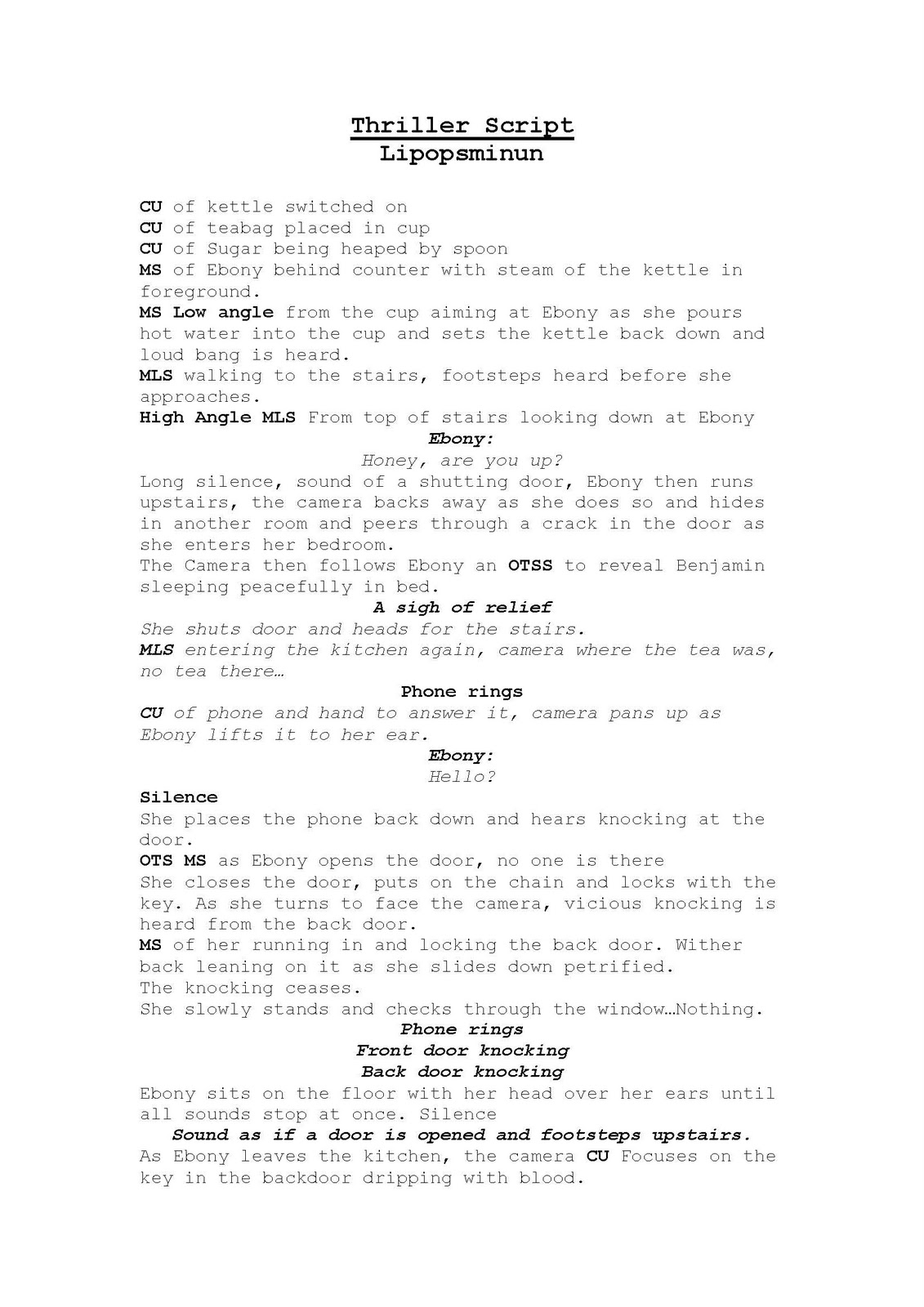
As mentioned earlier, this was not our original idea. The script for our first film Idea is below:

TEREATMENT


SHATTERED DARK
SYNOPSIS: Ebony Heart suffers from a mild form of schizophrenia, similar to her mothers. Only Ebony hasn’t been diagnosed with it. But this hasn’t stopped Ebony having the perfect life, her own house, a husband who doesn’t complain and caring neighbours. But this all changes when strange things start to happen. Phone calls late at night, banging on the front and back door....things going missing. Ebony is sure that someone is trying to break in but when you’re all alone and no one can hear you cry for help, it’s difficult to keep it together.
PLOT: Ebony is making herself a cup of tea, she puts the tea bag in followed by two spoons of sugar. Ebony yawns as she waits for the kettle to finish boiling, the steam rising in front of her face. Once the kettle is boiled she tips it to fill her cup and stirs her tea. A close up of the cup and Ebony stirring it we hear a loud bang a few seconds later. Ebony rushes through the living room, and footsteps running up the stairs can be heard, at the bottom of the stairs she calls up to her husband ‘honey you up?’ When she gets no answer she goes upstairs and opens a door, which leads to a dark room. After looking in, she exits the room and closes the door. The phone starts ringing and Ebony answers, no one is one the line so she hangs up. The front door bangs as someone hits it, and when Ebony checks outside no one is there. The phone starts ringing again, followed by the front door and the back door being banged against. Ebony falls to her knees and starts clawing at her head to try and block the sounds out. As she stands up a bloody handprint is seen on the door of the room she looked in. The camera then shows us the phone covered in blood, and a pool of blood on the floor. We finish with Ebony washing her blood covered hands before swapping to a shot of a blood covered hand of the body. Not long after the police are called out to her house and Ebony is the prime suspect and is taken into custody and questioned by Brendan Ford who is hell bent on ensuring that Ebony goes down for the crime as he is sure it is her. However she passes the lie detector test and is released, until Brendon seeks the help of Pamela Ivy a psychiatrist who analyses Ebony’s mental state and finds out she suffers from mild schizophrenia. Brendon now sure that she killed her husband won’t listen to Pamela who says if she did kill her husband it’s because of her condition, and she needs medication and help not a jail sentence. In the end Ebony ends up in a mental asylum and we take a look into her memories, the night her husband dies she comes home to find him having an affair with her friend Shannon, she kills them both but hides Shannon’s body in a hidden location. The film ends with Ebony laughing manically to herself saying over and over “you’ll never find her”

As stated earlier, this was not our original idea. Our original treatment is below:

Til Death do us Part
SYNOPSIS:
Young bride Ebony Heart looks forward to her ‘Big Day’, however a brutal betrayal and a tragic accident left Ebony widowed and alone. But when she sees the man of her dreams she finds herself questioning reality.....and her own sanity. Trusted by no one, not even the police, she finds it hard to ally herself with anyone. Discarding the thoughts of that night she finds herself trapped in an almost perfect world, but the question raised is....was she ever left alone in the first place. Unable to trust, unsure of whether she can love again, Ebony wonders where the line between life and death, reality and imagination can be drawn.
PLOT:
The film starts off with the brightly lit and decorated church doors opening, slowly as Ebony enters the church. Once inside the music ‘here comes the bride’ begins to play and the guests all turn to look at ebony walk down the aisle. After a couple of seconds of walking the aisle the church flickers from bright with guests, to dimly lit without anyone there. This continues to happen as Ebony walks down the aisle and we also see a change in Ebony, instead of wearing her white, clean and intact dress we are shown flickers of a torn, dirty and covered in blood dress. When she finishes her walk down the aisle she turns to face her groom and the Priest says to her ‘can I help you?’ to which the camera zooms into Ebony’s face before panning out and we can see the church is empty and Ebony is in her torn, dirty dress meaning that the scene from before is all in her mind and the empty church is real. As the camera moves away from the alter where Ebony and the Priest are stood we see her turn to face the Priest, and just before the church door closes we hear the Priests screams echo throughout the church. Ebony ends up being picked up off the street by Kathy Doyle a dedicated police officer who always follows her gut instinct, and when she sees Ebony’s blood covered dress she is positive that Ebony has murdered someone. When she is taken in for questioning Ebony doesn’t recall anything from the previous week and is in a state of distress, and when she passes a lie detector test Kathy is forced to let Ebony go. Ebony returns home where she ends up having a panic attack and her darker side comes out, she ends up going to a motel but she’s not sure why. Kathy does some background research on Ebony and finds out that she suffers from Schizophrenia which leads to panic attack s and forgetfulness. Kathy raises the alarm and goes out on the search for Ebony.  Meanwhile at the motel Ebony runs into Eric, the former best man who is drowning his sorrows at the bar of the motel at the news that his fiancĂ©e went missing. Ebony tells him to come up to a room she’s just rented out and they can talk things over. However when they get up to the room, Eric thinking he’s in for a promise is surprised when Ebony throws him down on the bed and holds a piece of cheese wire to his neck and explains what happened the night she came to this motel. She confesses that she murdered Benjamin and Louise because she found them in the same room that they’re in sleeping with each other.  Just as Ebony is about to kill Eric, Kathy bursts in and shoots her in the shoulder. Ebony ends up getting knocked out because of the force and pain. When Ebony awakes she finds herself in a mental asylum and we get a look into her memories of when she walks in on Benjamin and Louise. She kills them and hides their bodies before returning to the church we saw at the beginning of the film. The film ends with Ebony laughing manically and saying over and over “you’ll never find them”.